Meditation Across Traditions: What Unites Us, and the Distinctive Gift of the Vedic Path
Zen, Christian, Sufi, and Vedic meditation share five core principles. Discover what makes the Vedic contemplative path distinct — and how Jyotiṣa personalises the practice.
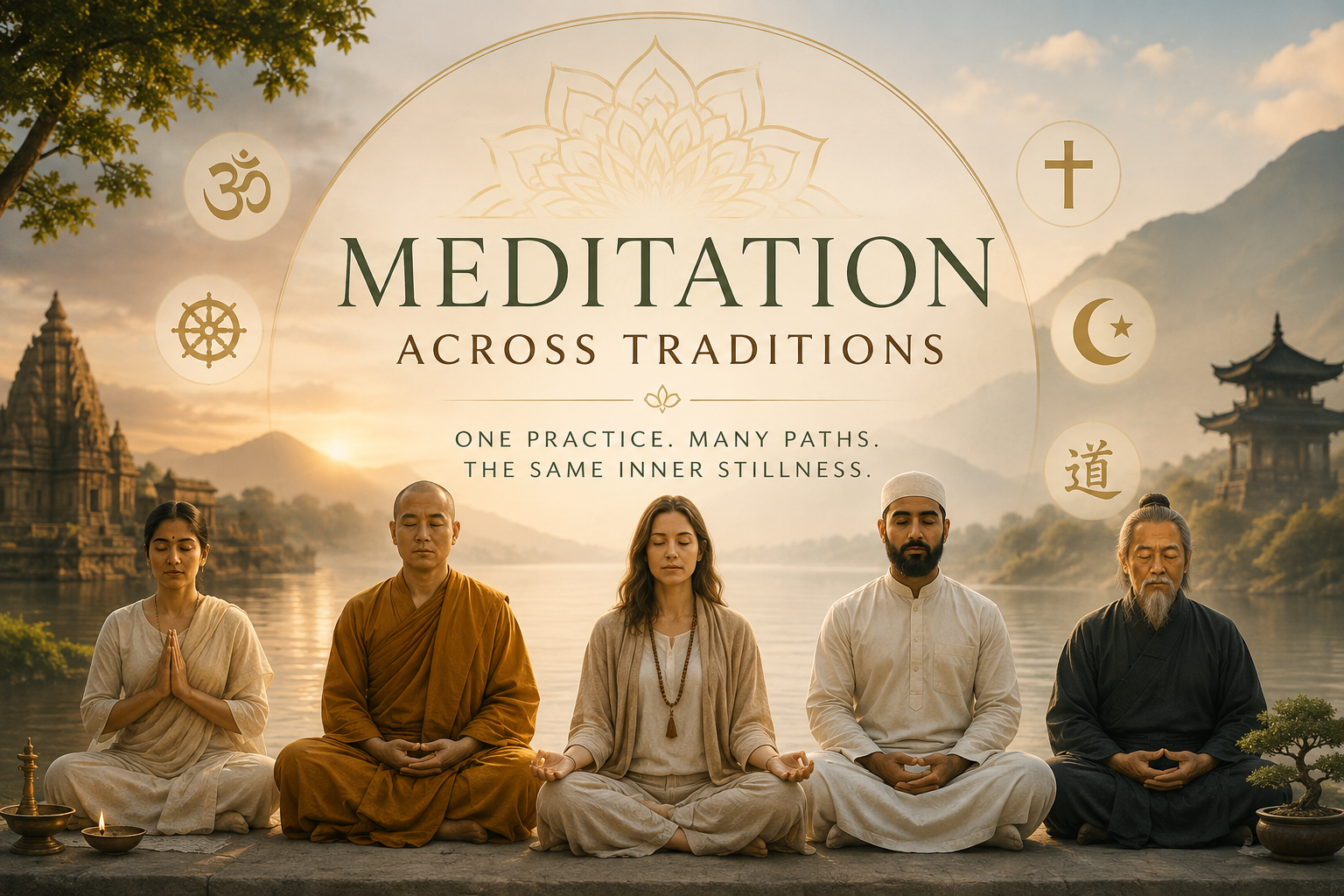
Zen, Christian, Sufi, and Vedic meditation all converge on five shared principles: stilling the mind, using the breath as a bridge, grounding practice in ethics, witnessing thought rather than suppressing it, and treating transformation — not relaxation — as the real goal. The Vedic tradition's distinct contribution is a detailed developmental map: meditation as one limb within an eight-limbed system, a cosmology that connects the individual to the wider universe, precise mantra science, sacred timing, and direct guru transmission.
Walk into a Zen monastery in Kyoto, a Trappist hermitage in the French countryside, a Sufi khanqah in Konya, or a small ashram on the banks of the Ganges, and you'll find people doing something that looks, on the surface, remarkably similar: sitting still, breathing with attention, turning inward. Meditation is one of humanity's oldest technologies for working with the mind, and nearly every wisdom tradition developed its own version of it. Yet each tradition also carries something particular, shaped by its own cosmology and aims.
This article looks first at what meditation practices around the world hold in common, then turns to the specific contribution of the Vedic tradition — the soil from which Jyotiṣa, Ayurveda, and Yoga all grew.
What Meditation Traditions Share
Despite arising in different centuries and civilizations, contemplative traditions converge on a handful of core principles.
Stilling the Mind to See Clearly
Buddhist samatha, Christian centering prayer, Sufi muraqaba, and Vedic dhyāna all begin from the same diagnosis: the ordinary mind is restless, reactive, and clouded, and clarity only appears once that restlessness settles. The methods for settling — following the breath, repeating a sacred phrase, gazing at a fixed point — vary, but the aim is the same: create enough stillness for something truer to be perceived.
The Breath as a Bridge
Breath awareness appears almost universally, from Buddhist ānāpānasati to the Vedic emphasis on prāṇa as the animating force behind consciousness. The breath is treated as the one autonomic process a person can consciously touch — a natural doorway between voluntary and involuntary experience, and therefore between ordinary awareness and something deeper.
Ethical Ground as a Precondition
Meditation is rarely presented as a stand-alone technique. Buddhist practice rests on the precepts; Sufi practice on adab and purification of the heart; Christian contemplatives on humility and charity; the Vedic tradition on yama and niyama, the ethical restraints and observances that precede meditative absorption in Patañjali's system. Across traditions, the implicit claim is the same: an unexamined, unrestrained life makes deep stillness very difficult to sustain.
Witnessing Rather Than Suppressing Thought
Mature traditions consistently distinguish between stopping thoughts and changing one's relationship to them. Zen speaks of "beginner's mind," Christian mysticism of "the cloud of unknowing," and the Vedic tradition of the sākṣī — the witness-consciousness that watches mental activity without being pulled into it. Whatever the vocabulary, the shift is from identifying with the mind's contents to observing them.
Practice as a Path to Transformation, Not Just Relaxation
Every major tradition treats meditation as instrumental to a larger goal — liberation, union with the divine, enlightenment, self-realization — rather than as stress relief alone. Calm is a welcome by-product, but it is not the destination.
The Distinctive Contribution of the Vedic Tradition
If these five principles form common ground, what does the Vedic path add that is genuinely its own? Several things stand out.
Meditation as One Limb Among Eight
In the Vedic-Yogic system codified by Patañjali, dhyāna is not an isolated technique but the seventh of eight interconnected limbs (Aṣṭāṅga Yoga), preceded by ethical restraint, physical posture, breath regulation, sensory withdrawal, and concentration, and followed by samādhi, absorption. This gives Vedic meditation a built-in developmental logic: it isn't something one simply "does" in isolation, but a stage prepared for by the limbs before it.
A Cosmology That Places the Individual Within a Living Universe
Perhaps the most distinctive feature of the Vedic approach is that it does not treat the meditator as a sealed-off, isolated mind. The individual is understood as embedded within a vast, intelligent, interconnected cosmos — the same consciousness animating the stars, the planets, the seasons, and the self. This is where Jyotiṣa and meditation naturally meet: because the birth chart is read as a map of one's particular relationship to cosmic forces, Vedic practice often personalizes contemplative work — recommending a mantra, a deity, or a practice period suited to an individual's specific planetary configuration, rather than offering a single universal technique for everyone.
Mantra as Vibrational Technology
While repeated sacred phrases exist elsewhere, the Vedic tradition developed an unusually detailed science of sound — the idea that specific Sanskrit syllables carry precise vibrational and energetic effects on consciousness, independent of their conceptual meaning. Japa, the repetition of mantra (often with a mala of 108 beads), is chosen deliberately: a mantra for Saturn differs from one for the Moon, and a mantra suited to easing anxiety differs from one meant to sharpen intellect. This precision — treating sound as a targeted instrument rather than a general aid to focus — is a hallmark of the tradition.
Time Itself as Sacred and Strategic
Vedic practice pays close attention to when one meditates, not only how. Brahma Muhūrta, the window roughly ninety-six minutes before sunrise, is considered especially favorable for sādhana, when the mind is said to carry less accumulated mental noise from the day. Auspicious periods such as Śrāvaṇa are treated as months when spiritual effort yields amplified results. This attentiveness to cosmic and calendrical timing — aligning inner practice with outer rhythm — is something the Vedic tradition emphasises with particular precision.
The Guru as a Living Transmission
While teacher-student relationships exist across contemplative traditions, the Vedic guru-śiṣya paramparā places unusual weight on direct, personal transmission — the idea that certain subtleties of practice cannot be learned from a text alone but are passed hand to hand, through relationship and example, across generations.
Bringing the Threads Together
Meditation traditions around the world are, in many ways, different dialects of the same underlying language: still the mind, work with the breath, ground the practice in ethics, learn to witness rather than react, and let transformation unfold gradually. What the Vedic tradition contributes is a remarkably detailed map for how to do this — situating the practitioner within a living cosmos, matching technique to individual constitution and chart, treating sound and timing as precise instruments rather than generalities, and carrying it all forward through a lineage of direct transmission.
Understanding your own birth chart is, in this sense, not separate from meditation practice — it is one of the tools the tradition offers for knowing which door is yours to walk through.
Frequently Asked Questions
Do all meditation traditions believe the same thing?
Not in their cosmology or ultimate goals, but they converge on method: stilling the mind, using the breath, grounding practice in ethics, and cultivating a witnessing awareness rather than suppressing thought. Where they diverge is in what they believe practice is ultimately for.
What makes Vedic meditation different from Buddhist meditation?
Both share core techniques like breath awareness and concentration. The Vedic tradition's distinct contributions are its eight-limbed developmental structure, a cosmology that ties the individual to the wider universe via the birth chart, a detailed science of mantra sound, attention to sacred timing, and an emphasis on direct guru transmission.
What is Aṣṭāṅga Yoga's eight limbs?
Patañjali's system moves through yama (restraint), niyama (observance), āsana (posture), prāṇāyāma (breath regulation), pratyāhāra (sensory withdrawal), dhāraṇā (concentration), dhyāna (meditative absorption), and samādhi (full absorption). Meditation is the seventh limb, not a stand-alone practice.
Why does timing matter in Vedic meditation practice?
Vedic practice treats certain windows — such as Brahma Muhūrta before sunrise, or auspicious months like Śrāvaṇa — as periods when the mind carries less noise or spiritual effort yields amplified results. Aligning practice with these rhythms is considered as important as the technique itself.
About the Author
Elle Feurtado is a Jyotiṣa Pandita trained in the classical Vedic astrology tradition through direct guru lineage, offering birth chart readings through Vedic Astrology 369.
Ready to explore your own chart?
A personal consultation with Elle brings your chart to life — with clarity on timing, purpose, and the patterns that shape your path.